Monday, March 17, 2014

Hunting for Answers

The ultimate victor of the civil war was not decided on one day, or by one battle, but rather by dozens of battles and events that contributed to the outcome of the war. In my History class we learned about many of the battles in the civil war. A total of twenty battles were assigned to people throughout the class, we worked either alone or in groups of two. We then researched the battle using reputable sources (not JUST wikipedia), and determined who the victor was, who the commanders were, and what type of battle it was (which theater). (Link to my google doc HERE). We then used the link from our google doc to create a QR code which functioned as a direct link to our google doc, and could be scanned from any smartphone or tablet that has a camera.
As you can see at the end of the google doc that I linked you to, there are directions to the next battle site. This is the location where the next QR code can be found. Each document had this, so the scavenger hunt could be completed no matter where it was started. After the scavenger hunt was complete, the class collaborated on Padlet, which allowed us to share what we learned with each other and understand what happened in the war.


These discussions allowed us to determine what really happened in each theater of the war, without confusion.
We were then tasked to answer two essential questions, the first being "Who was the ultimate victor in each of the theaters of war: East, West, and Naval?" In the Western theater the Union was the clear victor. The union claimed definitive victory in every battle except the Battle of Chickamauga, which was only lost due to poor union planning and execution, not due to good confederate maneuvering and tactics. In the naval theater, The Union was the victor. In the battle of Fort Henry, the union was the clear victor. They effectively used naval bombardment to devastate the fort. In the battle of Hampton Roads, there was technically no "victor" but the relentless assault of the Merrimack was halted and turned away, protecting the Union land advance and reassuring their Naval dominance. The Eastern theater was a completely different situation. The Confederacy had most of the early victories thanks to very opportunistic actions by Robert E. Lee and other confederate generals. However, once Grant and other, more "competent" generals from the union took over command in the Eastern theater, the union began to win. I believe that the union was the ultimate victor in the Eastern theater, because by the end of the war, they were winning most of the battles.
The second essential question was: "What are some commonalities that you can identify in the reasons for the results of the battles?" Most of the confederate victories were due to well thought out plans and defensive tactics by Confederate generals. The confederates often made the union generals make mistakes, then capitalized on these mistakes and used this to win the battle. In many of the Union victories, the union army was able to outnumber and overwhelm the confederate resistance. This is because the north had a greater population, and therefore more soldiers to fight in the war. Many of the victories were also due to great leadership from generals like Grand and Meade. These generals were able to secure important Union victories.
Students Scanning in to a QR Code

Personal Preservation or Patriotism?

In this blog post I will be talking from the point of view of a 18 year old clerk in a town in Massachusetts. The clerk will be debating whether or not to fight in the upcoming civil war.

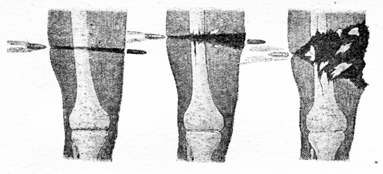
Many of my friends are rushing headlong into this "War Between the States" without any regard for their own safety. They say that it is my duty as a god-loving American to defend my states, and to fight for the rights of all people in this country. I am wary though, I have heard of the great dangers and atrocities of the war. They say that there are bullets that can be fired from a half-mile with accuracy, and could shatter bones. I have heard that if you get shot in the leg or arm, an amputation may be necessary. I can not imagine living my life without a leg or arm. Even worse than the initial wounds and amputations, thousands of men, just like myself are dying from horrible infections every day. Even a wound as insignificant as a shot to the finger can cost someone their life if not treated properly. The battle at sea is not faring much better, I have heard that the blasted confederates have such a ship that is plated in iron, and cannot be damaged by cannon shot. It has already destroyed many of our ships, and seems like it cannon be stopped by anything we can throw at it. 
This  shows the devastating injuries that the new bullets in the civil war could inflict

Even with all of these dangers, I realize that my country needs young men like me to serve (and die) for the cause. If we are ever to liberate ourselves from the scourge of slavery, it is necessary to make some sacrifices. I believe that we have the advantage in the war over these southerners. Here in the north we have been able to convert many of our factories for the purpose of making new and better weaponry. My father who works with the states says that hundreds of military patents have been filed. Here in the north we have more young men like myself who are willing to fight, so I may not even need to be used for front-line combat. In the west, there is talk of a great general for the north, Grant. I wish that I could serve under such a military genius as him. I have decided that it would be better to serve my country and die, than to not serve and watch my country lose. I will go to war for my country.

photo URL http://digital.library.upenn.edu/women/adami/camc/199-100dpi.gif

Monday, March 10, 2014

Informing Infograms

An Infogram is a powerful online-based learning tool, which resembles an interactive poster. The focus of Infograms is to convey a message with charts, diagrams, and using as little text as possible. In history class, we were tasked with creating an Infogram that displayed the differences and advantages between the North and South before the Civil war. We were to analyze how these differences affected each side's strategy, and how they affected the outcome of the war.


We chose to use the facts and information that seemed most pertinent to the outcome of the war. Ellie and I thought that information like population, factory workers, and railroads were important to the outcome of the war. We chose to use multiple visuals first in the Infogram, to attract the viewers attention, before getting to the more information-dense portion of the Infogram. We chose to represent the North with the color red throughout the infogram, and the south with the color blue. This allows the viewer to keep the information straight. By associating the information with a color, the viewer will remember the information more effectively.
By researching and creating this infogram, we have learned a great deal about the situation in which the North and South were in leading up to the civil war. It became evident to us that the North had a majority of the advantages in the war, which definitely contributed to the eventual victory of the North in the Civil War. The advantages in resources of all kinds, and the need for an aggressive war, meant that the north had the resources to support a war and the means to win it. The north had more soldiers, and with more gun production their armies were better prepared. The only true advantages that the south had, were that they: did not have to fight an aggressive war, they just had to defend their land, and that they had most of the military universities, which meant their commanders were better. This imbalance in resources and tactical advantages contributed to the triumph of the North over the South.

Monday, March 3, 2014

Causes of the Civil War Project: Bleeding Kansas

For this project, we worked in groups of two people. Each group was assigned a topic that was one of the causes of the civil war. Thomas and I were assigned "Bleeding Kansas" and we had to relate the events of our topic to the themes of conflict, compromise and slavery. Each group created an online project that could be viewed from any device, and we were able to learn about each topic from everyone's projects. We then assembled a timeline based on the events, with short descriptions on each event.

Link to My project: http://parker942.edu.glogster.com/bleeding-kansas-page1/ 

Timeline of all projects:


Thursday, February 13, 2014

EdCafe Reflection: Yea or Nay?

The EdCafe was an interesting new experience to discuss topics. Instead of simply having one large class discussion, where few people were able to talk, 12 individual discussions took place, 4 at a time. This allowed people to be present at a total of 3 conversations (one of which they led). These types of discussions fostered a more open and lively conversation than a massive class discussion. The smaller groups of 4-6 people allowed people to contribute more freely. I enjoyed that the students were allowed to choose the EdCafe that they wished to attend for each time block, this meant that no one was forced into a conversation where they had little to say. To make the discussion better for the future, it would be helpful for each set of group leaders to come with visuals such as this diagram.
Venn Diagram used by Ellie and Simone to help present
Visuals would allow people to focus more on the discussion, and not have to stop constantly to take notes.

When Thomas and I presented, it went quite well, a hearty discussion was present for the entire time allotted for the EdCafe. There was little down time, where people were waiting for the next discussion question or there was nothing to talk about. The discussion questions which Thomas and I prepared were interesting and unique, so there was not much repetition from other discussions. Our discussion, and way of leading it fostered a friendly environment where all members felt free to talk, no one person was dominating the discussion. One thing that I would like to improve for next time is using a visual to aid in the discussion. I felt that the need to note-take was detracting from the depth and vibrance of the discussion. If we used a Venn-diagram or other note-taking visual, the members of the discussion would have been able to just take a picture of it after the discussion.

I was a good attendee at the two discussions I participated in. I was prepared for each discussion because I read the narrative which the discussion was about, and came to the discussion with a good knowledge of the narrative. I contributed when it was fit for me to contribute, but I tried not to dominate any discussion I was in by talking too much. Sadly, I do not think that my notes were an accurate representation of what I learned at the discussion. I was more focused on the discussion itself, and I did not wish to take away from the discussion by stopping every 30 seconds to type up notes on what was just talked about. If I had stopped often to take notes, I would have been less productive in the discussion. Overall I was pleased with the EdCafe format of discussion, and I hope to continue doing discussions in this manner in the future.


Wednesday, February 5, 2014

The Not-So-Anti-Slavery North

It is often assumed by many Americans, specifically people in the northern states, that in Antebellum America the northerners were against slavery. However, this is not the case. Many northerners supported slavery based on economic grounds. Some northerners relied directly on slavery for their income.
One family, the DeWolfs, out of Rhode Island were one of the leading families in the slave trade. From the year 1769 to just before the civil war, more than 10,000 free Africans were brought into the country on DeWolf ships. The importation of slaves was outlawed in 1808, but the DeWolf family was so powerful that they had influence with the president and were able to continue their business. The DeWolfs developed a triangle route of trading that involved Rhode Island, Cuba, and the African coast. They were trading rum and slaves and reaping a massive profit. This family of northerners were clearly not against slavery, they were supporting its continuation by illegally bringing more slaves into America, and continuing to sell them. This economic dependence on slavery by northerners led to many northerners resisting abolitionist movements.

This chart shows how the economy of Lowell was dependent on slave labor. The textile factories were completely dependent on the cotton that was harvested by slaves. The slave population can be seen to clearly coincide with a dramatic increase in jobs in the Lowell mills, and an increase in cloth production in Lowell. This means that the more slaves that were brought into the united states resulted in a greater profit for the owners of the mills and more jobs for the lower class workers. This means that the jobs of the workers depended on the slavery of millions of blacks. 
This broadside from a Public Meeting in Lowell is strongly advocating against slavery. The persons at this meeting claimed that they are against abolition because they believe that it is an "infraction of their [southerners] rights". The glaring irony in this statement is ridiculous. The people of Lowell are so concerned for the rights of the southerners, but what about the rights of the millions of blacks who are enslaved? The first signer of this broadside is none other than Kirk Boot, an owner of a mill in Lowell. 
Although some citizens of the north were against slavery on moral grounds, much of the population depended on slavery for their welfare and therefore supported slavery. The perception of a "morally superior" north is definitely not true.

Pictures: 
http://www.edline.net/files/_wdH6e_/044829789f60d8f83745a49013852ec4/Unit_4_Activity_5_Doc_8_Broadside.pdf

http://www.edline.net/files/_wdH5g_/e9aa25b9887eebbc3745a49013852ec4/Unit_4_Activity_5_Doc_2_Cotton_Prod_v_Slave_Pop.pdf

Monday, December 16, 2013

Nineteenth Century Protestant Revival

The protestant revival caused a great renewal of love for god in the common people of the time. The new ideas of revivalists appealed to many people. One method of getting this new message out to the masses was by having massive "camp meetings." These were events in which a stage was built, and a preacher would spout holy fire for thousands of listeners to hear. These events could last days, and even as long as a week in some cases.
Religious Camp Meeting
By J. Maze Burbank, 1839
J. Maze Burbank was an artist of relatively high esteem at the time. He exhibited this watercolor in the Royal Society in London. However, it is unknown what specific preacher this was, when it occurred or where it occurred. Because the creator of this painting had no known religious bias, it is assumed that he was painting this from a neutral point of view. Burbank described the watercolor as, "a camp meeting, or religious revival in America, from a sketch taken on the spot." When this painting was produced, the Protestant Revival was sweeping across the nation, and especially in the Northeast. Preachers and revivalists such as Lyman Beecher and Charles Grandison Finney were important figures in the revival movement. We can see from this painting that the speakers at the camp meetings were very powerful and sent a strong message. There are people in the crowd weeping, rejoicing and everywhere in between. However, this painting shows just one camp meeting, and there were likely hundreds throughout the protestant revival movement. We are not able to see whether all camp meetings were so emotional as this one. The author was not trying to convince us of anything, for he was simply recording the events that transcribed at this event.

J. Maze Burbank, Religious Camp Meeting, Watercolor, 1839, Old Dartmouth Historical Society-New Bedford Whaling Museum, New Bedford, Massachusetts